ParcelScout
Cheap raw-land listings, scored honestly. Built to take an address, pull public records, query FEMA / state water / county GIS, and returns a tier, a composite score, and the reasons — never a probability of appreciation, never a "buy this" verdict.
Where the app stands today (27 September 2026): evaluating a parcel works for Pinal County, Arizona — paste an address and the app matches it to the county's parcel record, pulls FEMA flood and Arizona water data, and returns a tier, score, confidence and reasons; measured end to end on 20 September. Data: each county's GIS or Assessor, public record, not warranted. The in-app ZIP search sits behind Pro, and Pro is not switched on and cannot be bought yet.
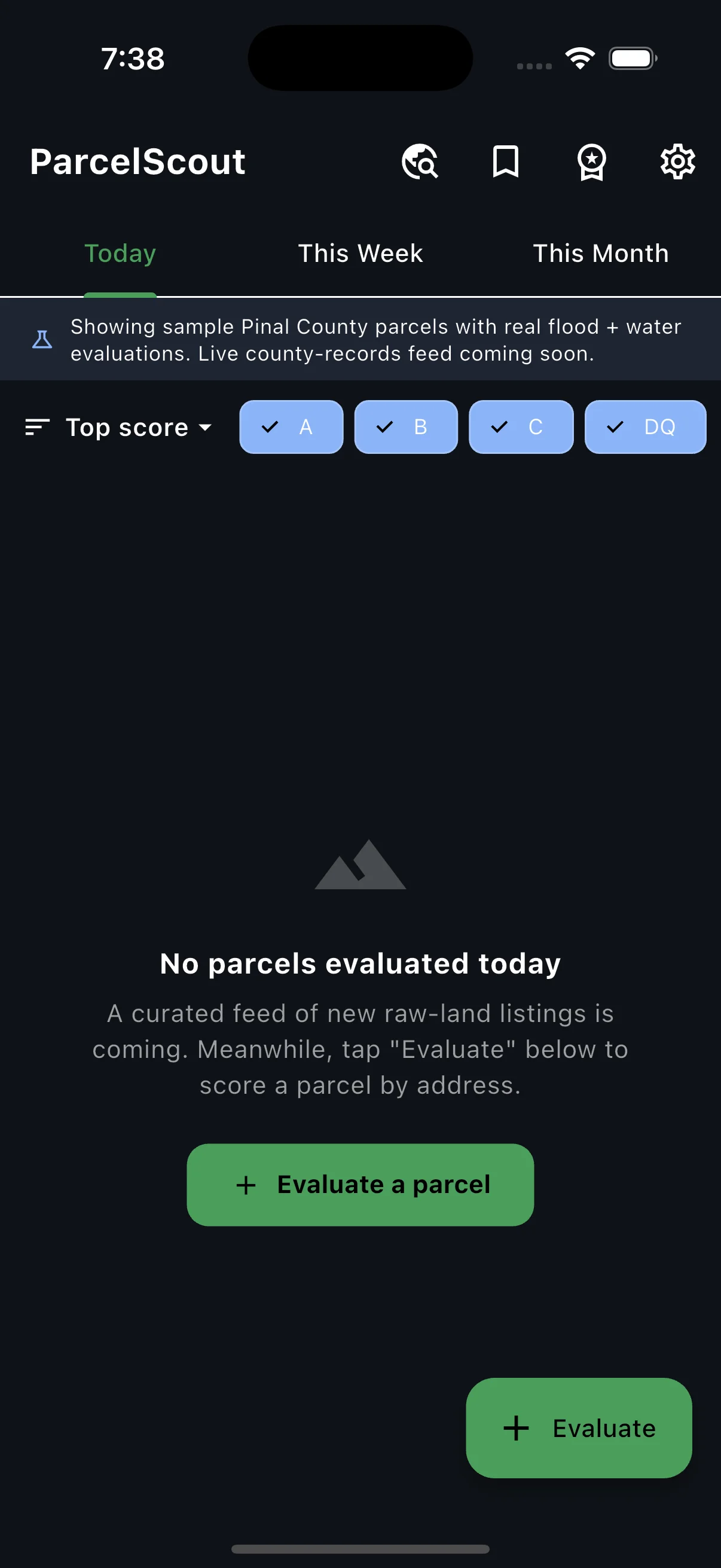
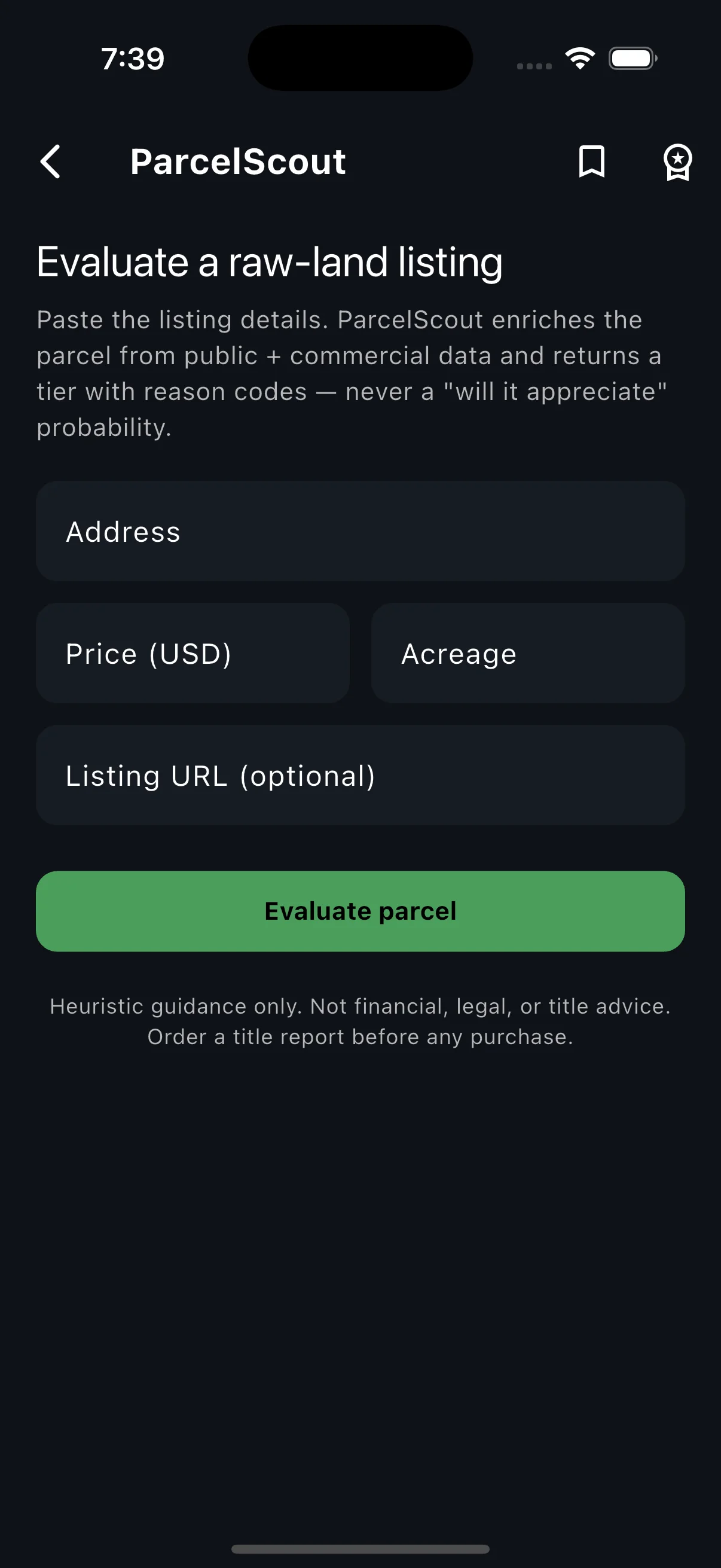
Paste a listing. Get the form, not a promise.
A real screen from the live app: address, price, acreage, and an optional listing URL — with the disclaimer shown right on the screen, not buried in a footnote.
Five-acre listings are a minefield. ParcelScout walks it.
Cheap raw-land listings can be landlocked, in a floodway, or in an AMA with no water right, and they can look identical at first glance. ParcelScout does the boring public-records work — across FEMA flood layers, state water boundaries, county records — and shows you what the records say.
Paste → match → enrich → score.
1. Paste an address
Just an address. ParcelScout geocodes it and matches it to a real parcel by APN — the canonical identifier the county uses.
2. Enrich from public records
Point-query the agencies that own the polygons: FEMA NFHL for flood zone and floodway, state water authority for AMA/INA boundary and community-water-system service area, county assessor for zoning and assessed value.
3. Score it deterministically
A pure, testable scoring engine combines six subscores — growth, water, access, price, infrastructure, title — into a composite 0–100. A separate confidence value flags how much of that score came from authoritative sources vs. inferred. Hard knockouts (landlocked, in floodway, in an over-allocated AMA with no water) override the composite entirely.
A tier, a score, a confidence, and the reasons.
Tier (A / B / C / DQ)
A heuristic bucket. A = high composite and high confidence. B = solid composite. C = weak. DQ = a knockout fired and no score can rescue it. Tiers are heuristic — explicitly labeled that way in the UI — not a probability of anything.
Composite + confidence, separately
The composite is a 0–100 weighted blend of the six subscores. Confidence is 0–1 and tracks how much of the input came from authoritative sources (gov GIS, county records) versus aggregator data versus scraped listing text. A 78/0.4 reads as "promising but unverified" — different from a 78/0.9.
Knockout reasons + risk codes
Disqualifying findings are surfaced first: no recorded legal access, in FEMA floodway, in an over-allocated AMA with no water provider and no well feasibility. Below that, the top positives and top risks, each tied back to the underlying record.
Standing "order a title report" flag
Recorded access, liens, and CC&Rs cannot be confirmed from the public layers ParcelScout queries. Every non-DQ result carries a permanent banner that says so. The app advises — it never clears a parcel for purchase.
What ParcelScout will never say.
This is product-defining and not negotiable.
🚫 Probability of appreciation
No "% chance to double," no "expected return." Those numbers are not derivable from the data available here. Putting one on screen would make the tool misleading.
🚫 "Buy this parcel"
Tier A means "high composite, high confidence." It is not a purchase recommendation. The title-report flag stays on for every non-DQ result, forever.
🚫 Investment advice
A standing "not financial / legal / real-estate advice" disclaimer is shown on every evaluation. ParcelScout surfaces public records; you make decisions.
Authoritative GIS for the polygons and county records for the parcels.
Authoritative (gov, free)
FEMA NFHL — flood zone and floodway, queried
by parcel centroid via ArcGIS REST.
State water authority (ADWR ArcGIS) — AMA / INA
boundary, community-water-system service area.
US Census Geocoder — address → lat/lng.
County records (free)
County GIS, public record (Pinal County Assessor; Cochise, Mohave, Coconino, Santa Cruz and Navajo County GIS — Navajo parcel data © Navajo County GIS, CC BY 4.0) — APN, parcel centroid, acreage as recorded by the county assessor, assessed value where the county publishes it. Regrid is no longer used.
Reports from people who have been there.
Public GIS layers say one thing; the parcel often says another. The cottonwood blocking the driveway, the easement that isn't recorded, the well that came back dry — those are corrections only a buyer who's actually been there can supply. ParcelScout lets you submit those findings to a ground-truth dataset keyed by parcel. Each report carries your anonymous account ID until you delete your account.
Start free.
Free
A capped number of evaluations per month. Tier badge and the single top risk per parcel. The standing title-report flag and not-advice disclaimer.
Pro — not available yet
Pro is not switched on and cannot be bought, so there is no price to quote. The in-app ZIP search sits behind Pro.
Public records, not personal data.
ParcelScout signs you in anonymously. We never ask for your name, email, phone, or any contact information. Listings you submit and evaluations you generate live under that anonymous ID and are deletable from Settings → Delete Account. Parcel records themselves come from public sources — they were never personal to you in the first place. No advertising SDKs. The app sends screen-view events to Google's Firebase Analytics, listed on its privacy page.